Xiaomi's Xring O1 examined: a fast, efficient chip with several custom parts
This week, Xiaomi introduced an in-house flagship chipset for smartphones and tablets, the Xring O1. It’s featured on the Xiaomi 15S Pro and the Xiaomi Pad 7 Ultra. Some expressed doubt as to how much Xiaomi actually did here – after all, the O1 uses standard CPU and GPU cores from the ARM parts bin. The team at Geekerwan did a deep dive and discovered that this is actually a heavily customized chip.
The Xring O1 is fabbed on the TSMC N3E node, the same as MediaTek’s Dimensity 9400. And it uses some of the same parts too – e.g. Cortex-X925 for the CPU and Immortalis-G925 for the GPU. However, the design is very, very different.
For starters, there are two Cortex-X925 prime cores on board, not just one. And Xiaomi skipped over the X4, instead opting for two variants of the Cortex-A725 for the big and mid-cores. And it added two A520 cores as a safety net.
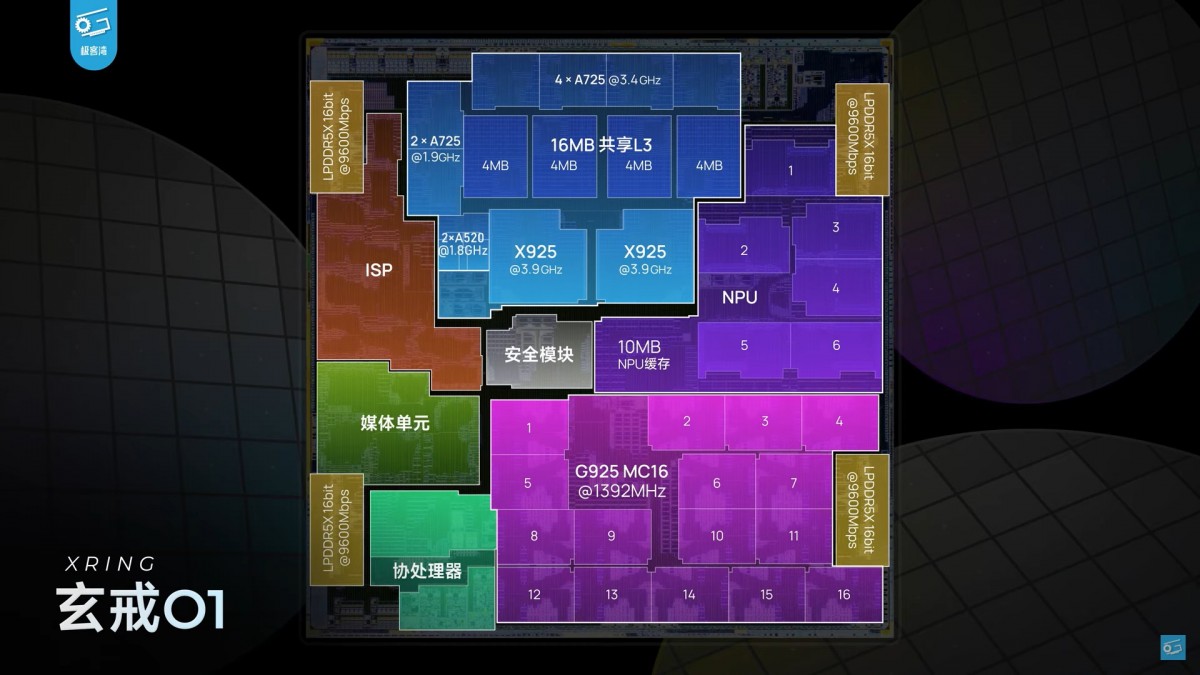
Those Cortex-A725 cores are an interesting element of the O1 design. There are two clusters – four cores designed for high performance and two more optimized for efficiency. In the die shot shown in the video you can see that the two efficiency A725 cores are physically different from the four performance A725 cores – they are a bit larger and are limited to a much lower clock speed (1.9GHz vs. 3.4GHz).
This allows the chipset to switch between cores to match performance requirements while using as little power as possible. The low-power A725 cores are so good that the two A520 cores may not have been necessary.
The end result is quite impressive – Xiaomi’s Xring O1 beats the Dimensity 9400 in terms of CPU performance and power efficiency. It’s not quite on the level of Qualcomm’s Snapdragon 8 Elite, but it’s not far off either.
The Xring O1 is fairly small at 109mm² – it’s about the same size as the Apple A18 Pro. However, both the Xiaomi and Apple chips use external modems, while the Dimensity 9400 and Snapdragon 8 Elite have built-in modems. This explains part of the size discrepancy (and creates an issue that we will come to later on).
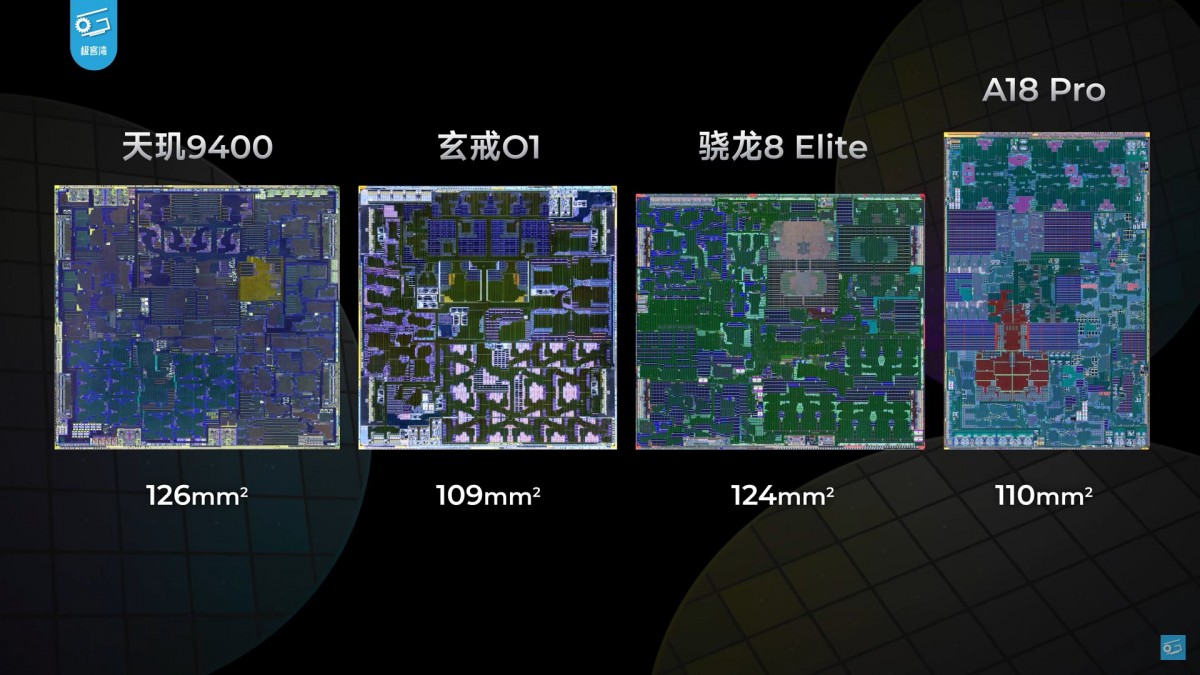
The Xring team configured the on-chip memory in an interesting way – most chipsets these days have several megabytes of System Level Cache (SLC), which is the last stop before having to fetch data from RAM.
The O1 has no SLC. Instead, Xiaomi configured the CPU with lots of cache – 16MB of L3 shared between all 10 cores, 2MB L2 each for the X925 cores and 1MB L2 for each of the A725 cores. The GPU has 4MB of cache and the NPU has 10MB – look at it, it’s huge!
The NPU is not an ARM design but instead a custom Xiaomi creation. The 6-core NPU takes up almost as much room on the chip as the CPU. The ISP is also created by Xiaomi, a fourth generation design. Previous generations have been featured as separate chips on the motherboards of Xiaomi flagships, but having it built in is more efficient.
Now we come to the GPU – a 16-core Immortalis-G925 from ARM. The Xring team did a brilliant job configuring the CPU, but it may have gotten it wrong with the GPU. For one, it’s quite big – the Dimensity 9400 has a 12-core G925.
Also, the Geekerwan team speculates that the omission of the SLC has hurt GPU efficiency – it’s pretty fast, but it uses more power than the Dimensity GPU at peak performance.
The more efficient CPU combined with the fact that the GPU rarely runs at full tilt makes for pretty good overall efficiency in real-life gaming tests. Still, this is an area that should be improved in future designs.
One more problem with efficiency – having an external modem (a MediaTek T800 in this case) uses more power, which hurts Xiaomi 15S Pro’s standby endurance. That is one of the reasons Apple worked so hard on having an integrated 5G modem (which made its debut with the iPhone 16e).
Xiaomi isn’t there yet, but it took the first step – it introduced its first 4G modem with the Xring T1, the chipset for the revamped Xiaomi Watch S4. 5G is a lot harder than 4G (it took Apple years to get it right), but it would be another major milestone towards vertical integration for Xiaomi.
With that, we leave you to watch the video, which goes into great detail on how the Xring O1 is built and how it performs:



Reader comments
- Anonymous
- mNn
The Xiaomi 16 base is rumored for a 6800mah battery already looking about as thick as Xiaomi 15 remaining 6.3" though it will be running on snapdragon 8 Elite 2




Tip us
2.1m 180k
RSS
EV
Merch
Log in I forgot my password Sign up